
Iron County Arrest History
An Iron County arrest can begin with the Iron County Sheriff’s Office, Cedar City Police, Enoch Police, Parowan Police, Utah Highway Patrol, Southern Utah University Police, or another agency with legal authority. The agency writes the incident and arrest report. If detention follows, Iron County corrections makes a separate intake record. Fingerprints may then support an arrest cycle at the Utah Department of Public Safety, Bureau of Criminal Identification, while a prosecutor and court create records only if charges are filed.
Those files are related, but none replaces the rest. An arrest report describes why an officer acted. A booking row shows that corrections received a person and lists intake data. A court file records filed charges, hearings, and the outcome. BCI compiles fingerprint-linked Utah events reported to the state. Iron County arrest history can therefore include a booking with no later case, a filed case with charges unlike the intake allegations, or an older event that is missing from one system because its identifiers were not matched.
Iron County Arrest Agencies
The report stays with the agency that made or documented the arrest. Iron County does not pool every police report into one search. Start with the place and agency named on the booking row, citation, or court file. That one detail prevents a common dead end: asking the Sheriff for a Cedar City Police narrative merely because the detainee entered the county jail.
| Agency | Record route | Custody or case route |
|---|---|---|
| Iron County Sheriff | Sheriff records request | Iron County corrections and the court where charges are filed |
| Cedar City Police | Police GRAMA form | County jail, Iron Justice Court, or Fifth District Court |
| Enoch or Parowan Police | The city police records custodian | County jail and the proper Iron County court |
| UHP, SUU, or state agency | The arresting agency’s own GRAMA channel | County jail if held locally, then the filing court |
For a Cedar City event, the Police Records and Support unit is at 2130 N Main Street, Cedar City, Utah 84721, and its main line is 435-586-2956. The front desk is open weekdays from 9 a.m. to 5 p.m. The city’s 24-hour dispatch line is 435-586-2955, but the records desk handles copies. Enoch and Parowan requests must go to their own police custodians.
Looking Up Iron County Arrests
Use a full legal name, approximate arrest date, arresting agency, and report or case number when known. No one Iron County lookup covers every time span and record type. The order below begins with the fastest custody sources, then moves toward retained and statewide records.
- Search the Iron County current-inmate roster, then the three-day recent-booking log. If a match is unclear or absent, call the jail at 435-867-7555.
- Identify the arresting agency. Ask that office for the incident or arrest report, and ask Iron County corrections for retained booking material. A narrow GRAMA request should include date, place, agency, and a known report or booking number.
- Search XChange or use a free courthouse terminal to see whether the prosecutor filed a case. Fifth District Court handles felonies and class A misdemeanors. Iron County Justice Court handles many class B and C misdemeanors, infractions, and county traffic matters.
- For your own fingerprint-linked statewide history, use BCI Right of Access. Utah does not provide an unrestricted public name search of BCI criminal histories.
- If online results fail, call the Sheriff or agency counter, mail or submit the proper GRAMA request, and contact the filing court. Use UDC Offender Search only for state incarceration or current adult probation and parole, not a new county-jail booking.
The Fifth District Court is at 40 N 100 E in Cedar City and can be reached at 435-867-3250. Iron County Justice Court is at 82 N 100 E, Suite 101, in Cedar City, and its main number is 435-865-5335. Those clerks hold the filed case, not the officer’s narrative.
A nationwide review of your own fingerprint-supported history uses the FBI electronic request portal, not an Iron County public name search.
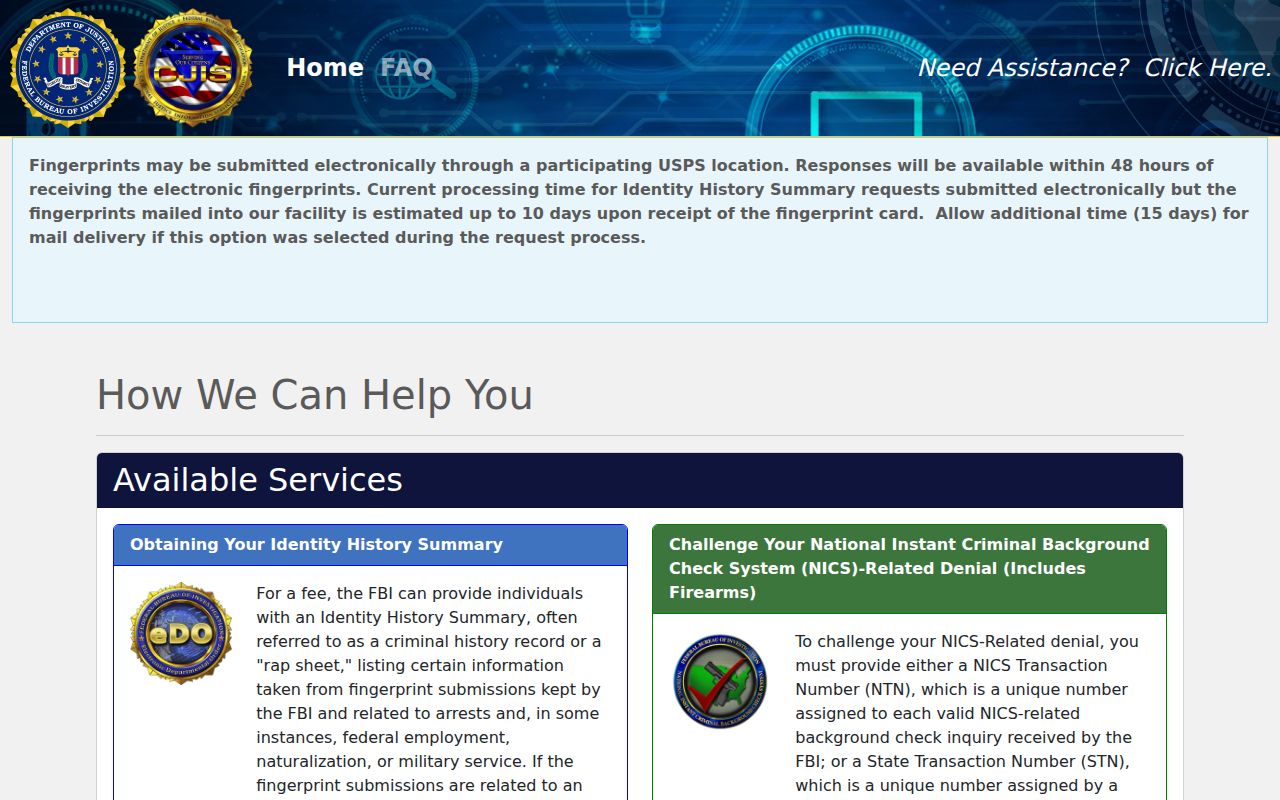
The FBI capture shows the official subject-request entry point. It supplements local and Utah sources but does not replace the arresting agency’s report or the filing court’s disposition.
Iron County Booking Flow
The local path is easy to misunderstand because the records do not appear at once. The usual flow is: Arresting agency report → Iron County booking → prosecutor review → court filing and initial appearance → disposition → BCI reporting and reconciliation. An officer may list probable-cause allegations at intake, but the prosecutor can amend them or decline to file. Court staff enter filings in CORIS, which then feeds XChange.
A missing XChange result soon after an Iron County arrest does not establish that no arrest happened. The booking may come before the court case, spelling may differ, or no charge may be filed. Check the roster, call corrections, and ask the arresting agency first. Then search the likely court again with a case number or broader date range. When reviewing your own history, compare the court disposition against the BCI arrest cycle. BCI warns that an event can be absent when fingerprints were not submitted, while court or corrections records may still exist.
The official text of Utah Code §53-10-108 supplies the state rules for BCI criminal-history collection and dissemination.
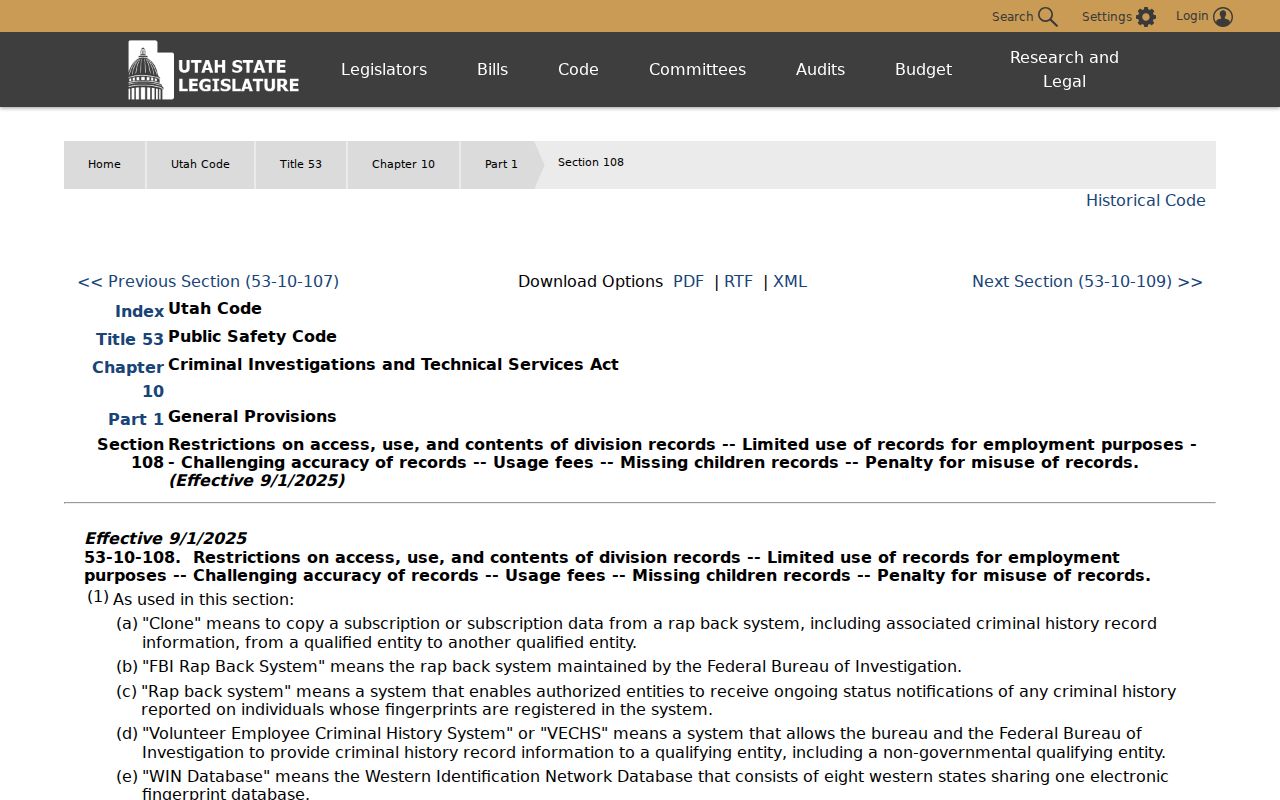
The statute image marks why BCI Right of Access differs from the Sheriff’s public roster: the statewide file is controlled criminal-history information, not an open public name database.
Note: Initial jail charges can change after prosecutor review, so save the booking date and match it to the later case number.
Inside an Iron County Arrest Record
An agency arrest report may carry more detail than the public jail tables. Iron County corrections records can include a booking number, intake time, photograph, fingerprints, charges, holds, property, and release data, though privacy and safety classifications restrict some fields. The public roster promises a much smaller set. Treat every charge label as an allegation until the filing court supplies the disposition.
| Report or booking number | A unique agency locator when one is released; the public roster does not promise a booking number field. |
|---|---|
| Date and time | The arrest report can show the event time, while jail data records the separate booking date. |
| Arresting agency | The office that owns the officer report; this appears in the three-day booking view. |
| Alleged offenses | Intake charge labels that may differ from charges later filed by a prosecutor. |
| Bond and holds | Current roster bond amounts and bond types, subject to the signed court order and other holds. |
| Booking photo | Generally withheld before conviction under the Sheriff’s HB 228 notice, apart from narrow public-safety exceptions. |
| Custody status | The recent log’s in-custody flag is a point-in-time display, not proof of later release or transfer. |
Victim details, juvenile material, medical or classification data, personal identifiers, and active investigative information may be withheld or redacted under Utah law. A releasable report is not necessarily an uncut copy.
Iron County Roster Fields
The official Iron County roster source shows how the current search is built.
The live interface confirms a name-or-offense search, a sortable booking date, and columns for offenses, bond amounts, and bond types. It does not advertise a profile page, date of birth, custody-unit assignment, warrant number, or court date. Do not infer those missing facts from an empty cell.
Both official Iron County booking tools refresh every ten minutes. A person may vanish from the current view after release or transfer, and a spelling mismatch can hide a valid row. Call the jail for an official custody check. UDC Offender Search is a separate system for people incarcerated by the state or under state adult supervision. It expressly excludes those merely awaiting trial or sentence in the county jail.
The county’s official jail proposal page documents a 1987 facility with a 180-bed design and plans once considered for a much larger replacement.
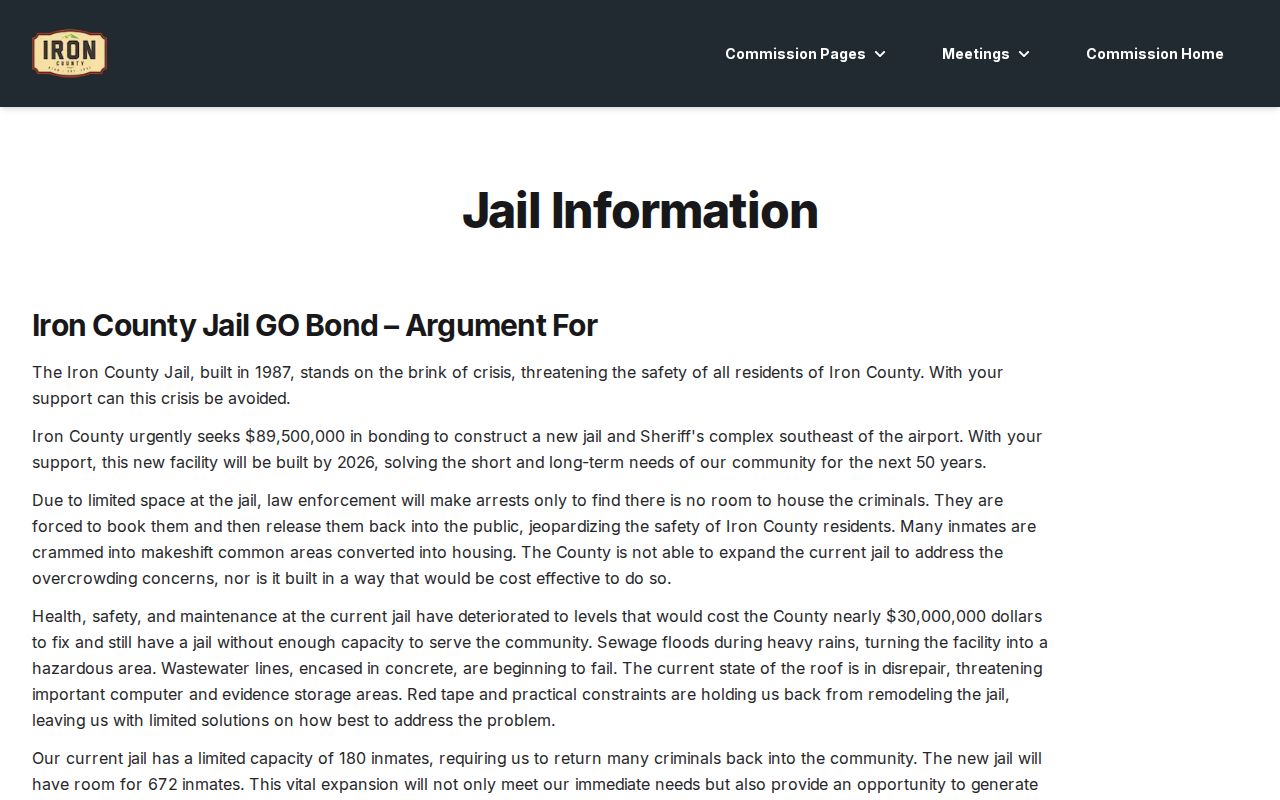
The proposal capture explains local capacity concerns, but it is not proof that the proposed complex was completed. Current custody facts still come from the live roster and jail phone.
Booking Logs and Recent Arrests
Iron County publishes two distinct views. The current-inmate roster focuses on people held now. The recent-booking log covers the prior three days, lists newest entries first, and shows agency, arrest type, booking date, offenses, and whether the person remains in custody. It is useful when an arrest was very recent but the person has already left the current roster.
The Sheriff’s recent-booking source displays that narrow date window without turning the log into a lasting arrest archive.
The live interface also carries the county’s booking-photo notice. Once a row rolls off, request retained booking material from the Sheriff and the incident report from the arresting agency. Absence from either live table does not prove that an older Iron County arrest never occurred.
Iron County Booking Photo Rules
Iron County does not present its arrest lookup as a public photo gallery. The Sheriff’s notice ties most pre-conviction booking-photo limits to Utah HB 228, effective March 18, 2021. Post-conviction or post-sentencing images may be requested under GRAMA. Narrow public-safety exceptions can permit release sooner, but the official sources do not promise a photo for every booking.
That limit matters when reading the recent log. No image does not mean no booking. It also does not speak to guilt. A booking photograph records appearance at intake and remains tied to an accusation unless and until the court reaches a result. Juvenile rules and private or protected classifications can narrow access further. Requesters should seek a photo only from the official custodian and state the date, agency, report or case number, and the disposition if known.
Utah access rule: GRAMA, Utah Code Title 63G, Chapter 2, permits records requests but also lets agencies classify or redact private, protected, controlled, sealed, and active-investigation material.
The official Utah GRAMA text sets the request, fee, classification, response, and appeal framework used for Iron County arrest records.
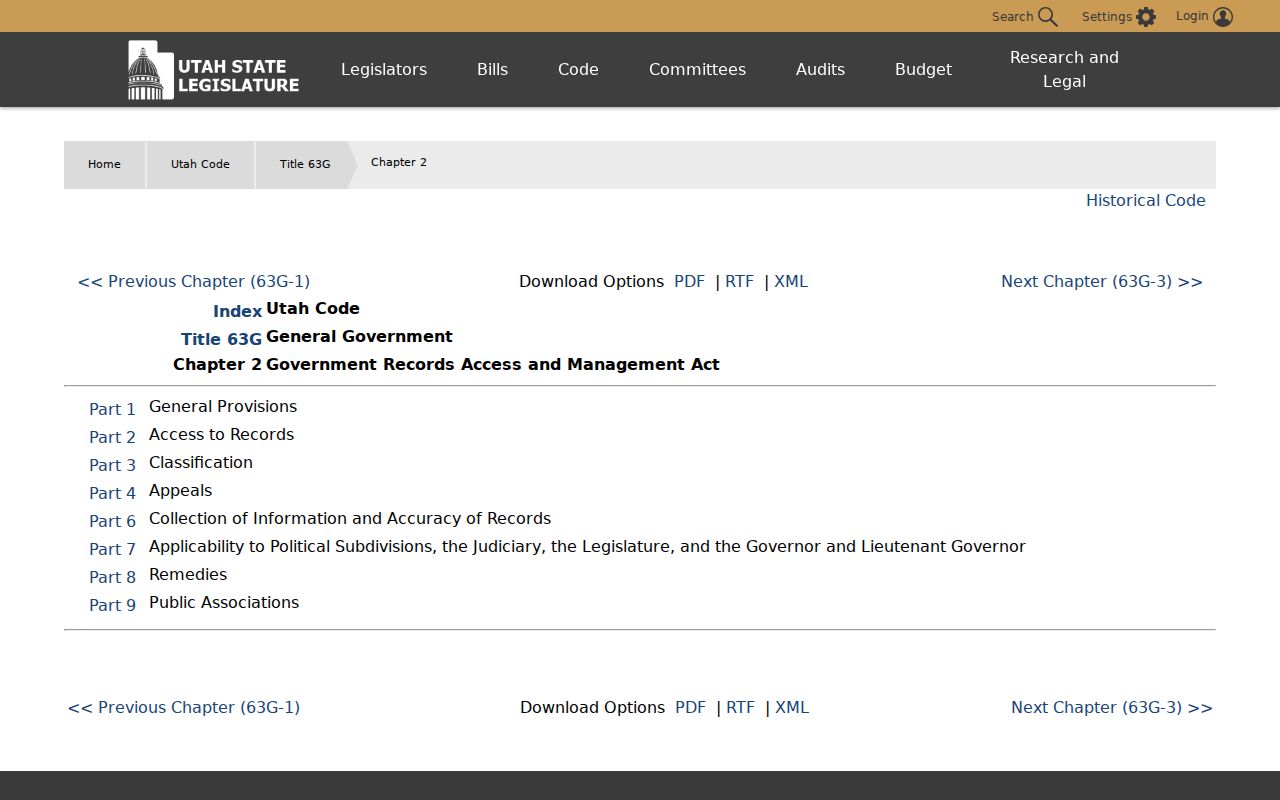
The statute capture supports the request route while underscoring that government possession alone does not make every booking or investigative detail public.
Iron County Arrest Report Requests
Use the online Iron County Sheriff record-request form for Sheriff reports or retained jail and booking material. The form asks for requester identity and contact data, the record description, status and fee choices, acknowledgments, and whether a booking photo is sought. It warns that processing may take up to ten business days, that estimated fees may need advance payment, and that identification can be required for private or protected records.
The official Sheriff form source shows the live request controls used for Iron County arrest records.
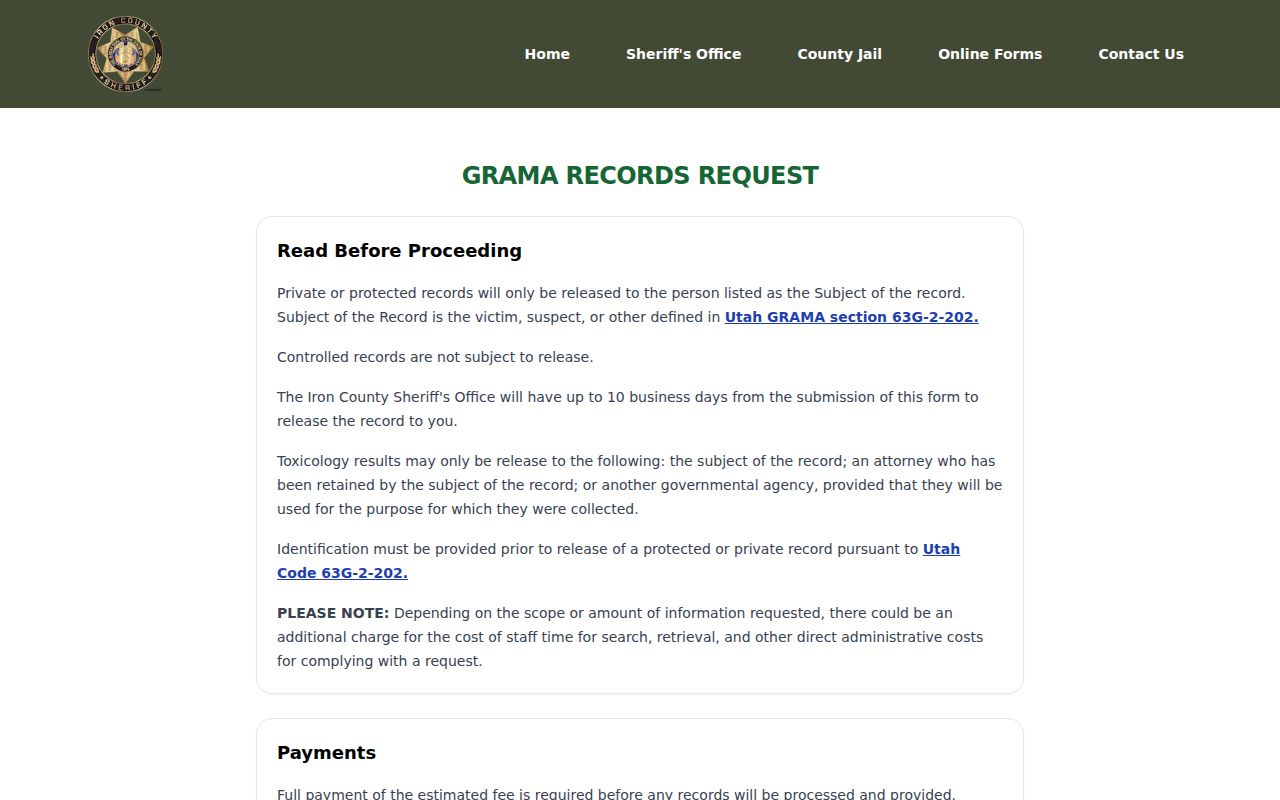
The form image reinforces why a narrow description works best. Give the incident date, place, arresting agency, precise record type, and any report, booking, or court number. Ask for electronic delivery and a cost estimate before work exceeds a stated limit. Under GRAMA, reasonable duplication, compilation, and redaction charges may apply.
Iron County Sheriff’s Office
2132 N Main Street
Cedar City, UT 84721
Office: 435-867-7500
Jail: 435-867-7555
Call before visiting to confirm the correct records or jail address.
Official county listings conflict on the jail destination: one lists Sheriff headquarters on North Main, while the county directory labels the jail on Iron Springs Road. Call before travel. For a Cedar City Police arrest, use that department’s GRAMA form instead of sending the report request to the Sheriff. For filed charge papers, use the court clerk.
Arrests Are Not Convictions
An Iron County arrest records an officer’s custody decision and, if booked, the jail’s intake. A conviction exists only after a court enters a judgment of guilt. Between those points, a prosecutor may decline a charge, file a different offense, or dismiss part of a case. A judge or jury may acquit. The public Iron County criminal court case file is the right source for the final charge and disposition.
| Arrest record | Conviction record |
|---|---|
| Created by the arresting agency and jail | Created through the court case and judgment |
| Shows an arrest or booking occurred | Shows a court found or accepted guilt |
| Held by police, Sheriff, and fingerprint repository channels | Held by the filing clerk and reported into state history systems |
| Can lead to release, no filing, dismissal, or acquittal | Can lead to sentence, appeal, or qualifying expungement |
Note: An Iron County arrest is not proof of guilt, and only the court disposition shows how a filed charge ended.